
Our work speaks for itself.Chestnuts, Bledington
Unlocking Planning and Environmental Permitting for a Domestic Extension in Flood Zone 3
Project Overview.
Project: Chestnuts, The Green, Bledington, Oxfordshire
Project Type: Domestic Extension (New Garage & Oil Tank Enclosure)
Architect: Seymour-Smith Architects
Key Services: Flood Risk Assessment (FRA), Flood Risk Activity Permit (FRAP) Negotiation with the EA, Flood Modelling.
The Challenge.
Following the submission of planning documentation prepared by Seymour-Smith Architects, the Environment Agency (EA) issued a formal objection to the proposed detached garage extension. Due to a lack of detailed localised modelling data, the EA applied a broad precautionary approach, designating the entire area within Flood Zone 3 as Zone 3b (Functional Floodplain). Under national policy, this classification automatically deemed the development type incompatible and led the EA to issue an objection to planning permission. The application could not progress until EPN Consultants was appointed to technically challenge this assumption and prepare a robust site-specific Flood Risk Assessment (FRA) to demonstrate that the development would not increase the risk of flooding elsewhere.
The Strategy.
Prior to drafting the Flood Risk Assessment (FRA), EPN Consultants initiated a formal technical consultation process with the Environment Agency (EA). This proactive engagement allowed us to establish the precise parameters and identify the necessary key points of the FRA in order to address the EA's initial concerns.
Our strategy focused on three key areas:
Policy Analysis: We thoroughly reviewed the Strategic Flood Risk Assessment (SFRA) for Cotswold District Council, identifying specific provisions that allow for local circumstances and existing site footprints to be factored into the flood zone assessment.
Regulatory Liaison: Based on our findings, we engaged directly with the EA Planning Advisor and successfully negotiated the removal of the initial objection. This critical breakthrough enabled the EA to allow us to submit a detailed site-specific FRA, shifting the focus to a practical, evidence-based review of actual flood risk.
The Planning Approval: With the parameters agreed upon, we prepared and submitted a compliant, site-specific FRA, which successfully led the EA to withdraw their objection and enabled the local planning authority to grant planning permission.
The Execution & Technical Solution.
Securing planning permission was only the first step; construction could not legally commence without a Flood Risk Activity Permit (FRAP) from the Environment Agency (EA) due to the site's proximity to the watercourse. To navigate this rigorous permitting phase, EPN Consultants managed two technical workstreams in parallel:
Contractor Alignment & RAMS Guidance
We collaborated directly with the contractor to oversee the mandatory Risk Assessment and Method Statement (RAMS) required for works near a main river. When the EA initially rejected the submittals, EPN provided technical guidance, iteratively refining the RAMS until the documentation fully aligned with the regulator's strict environmental and safety requirements.
Civil 3D Surface Analysis
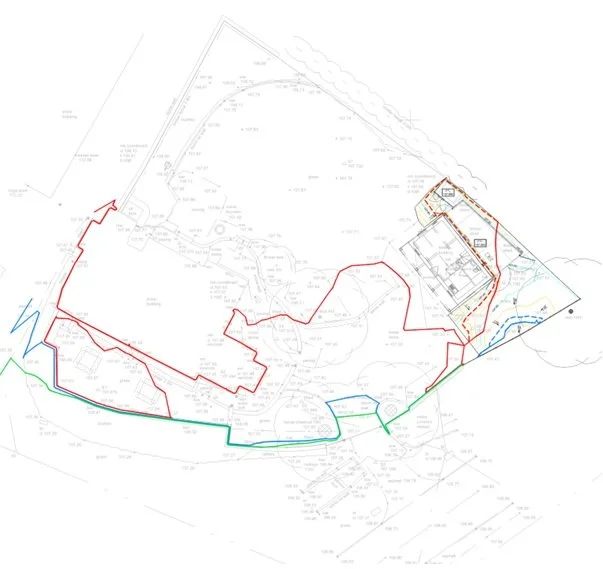
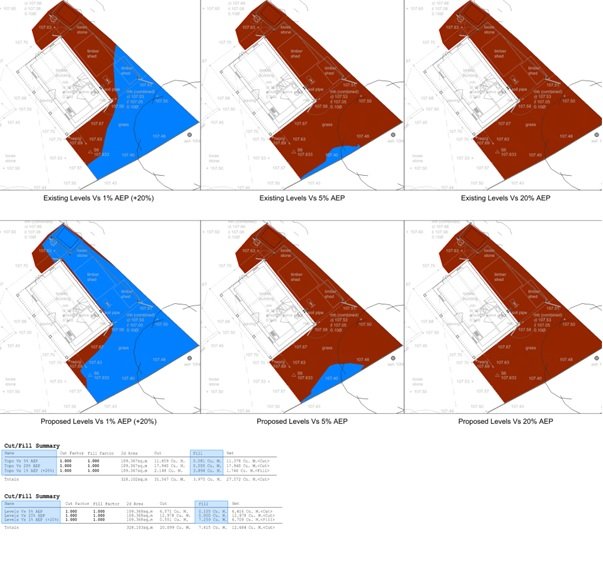
In response to a formal Schedule 5 Notice from the EA regarding potential impacts on floodplain storage, EPN conducted an advanced 3D terrain analysis. It was mutually acknowledged that under extreme weather events, the proposed structure would flood. To prove this would not negatively impact downstream properties, we utilized AutoCAD Civil 3D to model the exact terrain:
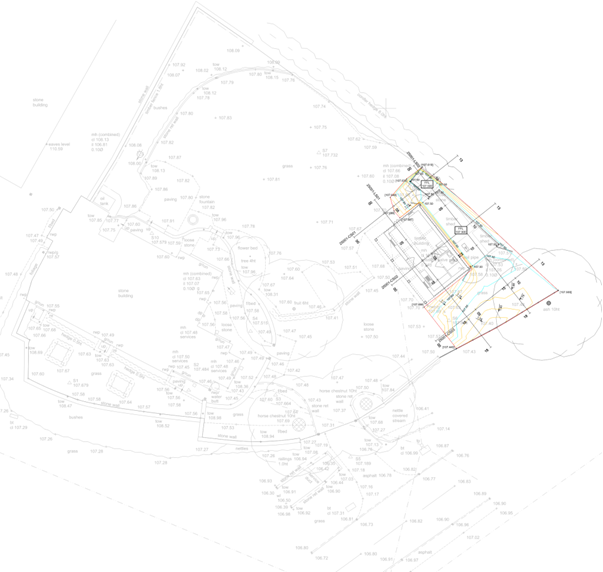
We generated precise 3D surfaces modelling for both the existing and proposed ground levels.
We simulated specific flood events over these surfaces to calculate exact volumetric displacement.
We demonstrated that by strategically lowering the ground levels, the final design would actually increase local flood storage capacity when the proposed structure flooded.
The Turning Point: Proactive Resolution
Following the submission of our detailed drawings and engineering calculations, the subsequent review cycles slowed as the EA repeated queries that had already been technically addressed in our submittals.
Rather than allowing the project to stall under regulatory gridlock, EPN took a proactive and pragmatic approach. We requested a direct technical review meeting with the EA officials. During this meeting, we systematically walked through every query, corresponding drawing, and dataset we provided. By addressing their concerns face-to-face with undeniable 3D modelling data, we successfully resolved all outstanding points, convincing the EA to grant the Environmental Permit so construction could safely begin.
The Result & Impact.
Project Timeline Protected: With the contractor lined up to begin on-site, any prolonged regulatory delay would have deferred the construction start date and incurred substantial standby costs. EPN's intervention prevented an expensive, open-ended project standstill.
Permit Successfully Issued: The Environment Agency officially issued the Grant of Permit, legally unblocking the construction phase.
Net-Positive Flood Impact: Our advanced 3D terrain modelling proved that the completed development would enhance local floodplain storage capacity rather than reducing it, providing long-term safety and compliance for the property.